
Marion County Criminal Court Records
A criminal court record in Marion County is the court file kept after the prosecutor files a complaint or information and the case is opened in District Court. The file may include the filed counts, Kansas statute references, bond orders, appearances, motions, plea entries, journal entries, disposition, sentence, probation terms, fines, fees, restitution, and warrant activity. The court record is the best source for what was actually filed and how each count ended, while arrest or jail records may only show the arresting agency and apparent booking information.
Marion County is part of the 8th Judicial District with Dickinson, Geary, and Morris counties. Felony cases and many misdemeanor, traffic, fish and game, juvenile, care and treatment, and appeal matters can be handled in District Court. The Marion County Attorney prosecutes felony crimes and select misdemeanor and traffic cases, then the Clerk of the District Court maintains the filed case record at the courthouse. Municipal ordinance cases may stay in a city municipal court unless the matter moves into District Court.
The formal court file is also different from the closer charge-focused record. Filed counts, amendments, reductions, and dismissals are part of the criminal case, but the arrest-to-charge pathway is covered in more detail in Marion County arrest records and court charges.
Search Marion County Criminal Cases
Start with Kansas Judicial Branch CaseSearch, the statewide public search system for Kansas District Court case information. The 8th Judicial District record search page directs users to CaseSearch for records from courts in the district. CaseSearch may show public case information and public documents when remote access is allowed by Kansas Supreme Court Rule 22. If a document is not visible online, a public record may still be available at a courthouse terminal or through the Clerk of the District Court.
- Open Kansas CaseSearch and choose a search path such as case number, party name, business name, citation, or another role-based option.
- Use the full case number when known. Kansas examples include formats such as 2019CV25 or RL2019CV25.
- Search by the defendant's name when the case number is unknown, then check the county and court before relying on a result.
- Open the public case information to review docket events, charges, hearing entries, disposition, and public documents.
- Contact the Marion County Clerk of the District Court when a certified copy, sealed-case answer, or courthouse-terminal review is needed.
For a current docket date, the 8th Judicial District Court Dockets page posts Marion County docket PDFs and related Zoom information. Payment data for some criminal, traffic, juvenile offender, and fish and game cases can route through the Kansas Courts Central Payment Center, but payment lookup is not a full criminal court record. The court file remains the source for pleas, disposition, sentencing, and later orders.
Marion County Criminal Case Flow
A Marion County criminal case can begin with law enforcement and the County Attorney, but the court record begins when the charging document is filed in District Court. The docket then builds as hearings occur and orders are entered. A single case can have several counts, and each count can move in a different way. One count may be dismissed while another count results in a plea, conviction, diversion, or sentence.
Case flow: Charges Filed › Arraignment › Pretrial and Motions › Plea or Trial › Disposition › Sentencing.
| Stage | What the Marion County record may show |
|---|---|
| Charges filed | Complaint or information, statute, count number, offense description, severity level, and prosecutor filing date. |
| Arraignment | Appearance, plea entry, counsel status, bond review, next hearing date, and any order made by the judge. |
| Pretrial and motions | Discovery issues, continuances, suppression motions, plea talks, amended counts, and journal entries. |
| Plea or trial | Guilty plea, no contest plea, trial setting, verdict, dismissal, or other count-by-count outcome. |
| Sentencing | Jail or prison term, probation, fines, court costs, restitution, conditions, and later revocation activity. |
Note: Court staff can explain access steps, but they cannot tell a defendant how to plead or whether to accept an offer.
Marion County Criminal Record Fields
The most useful criminal record fields are the ones that tie a person, count, hearing, and outcome to a specific District Court case. Kansas public systems may show less online than a courthouse terminal can show, and Rule 22 controls what can be viewed remotely. A public CaseSearch result should be read as public case information, not as a certified court record.
| Field | What it shows |
|---|---|
| Case number | The Kansas District Court record number used to track filings, events, and clerk requests. |
| Court and county | Marion County District Court, 8th Judicial District, Kansas, or another court if the result is not local. |
| Defendant and parties | The State of Kansas as prosecuting party and the named defendant, subject to redaction rules. |
| Charges and statutes | Count number, offense description, Kansas law cited, classification, and any amended charge information. |
| Docket events | Complaint filed, summons or warrant, arraignment, bond appearance, motions, orders, plea, hearing, sentencing, or dismissal. |
| Disposition | The outcome for each count, such as guilty, dismissed, acquitted, diverted, or otherwise resolved. |
| Sentence and financials | Probation, jail or prison term, fines, fees, restitution, bond, and outstanding balances when public. |
| Documents and redactions | Public documents where remote access is allowed, with identifiers, minor details, sealed material, and protected data hidden. |
The official Marion County Attorney page identifies the office as handling felony crimes, select misdemeanor and traffic prosecutions, juvenile offenses, care and treatment matters, child-in-need-of-care actions, criminal appeals, and related matters. That scope explains why a Marion County criminal court record may include more than a simple arrest charge or traffic ticket.
The Marion County Attorney page shows the local prosecution office used for criminal filings. View the Marion County Attorney source page.
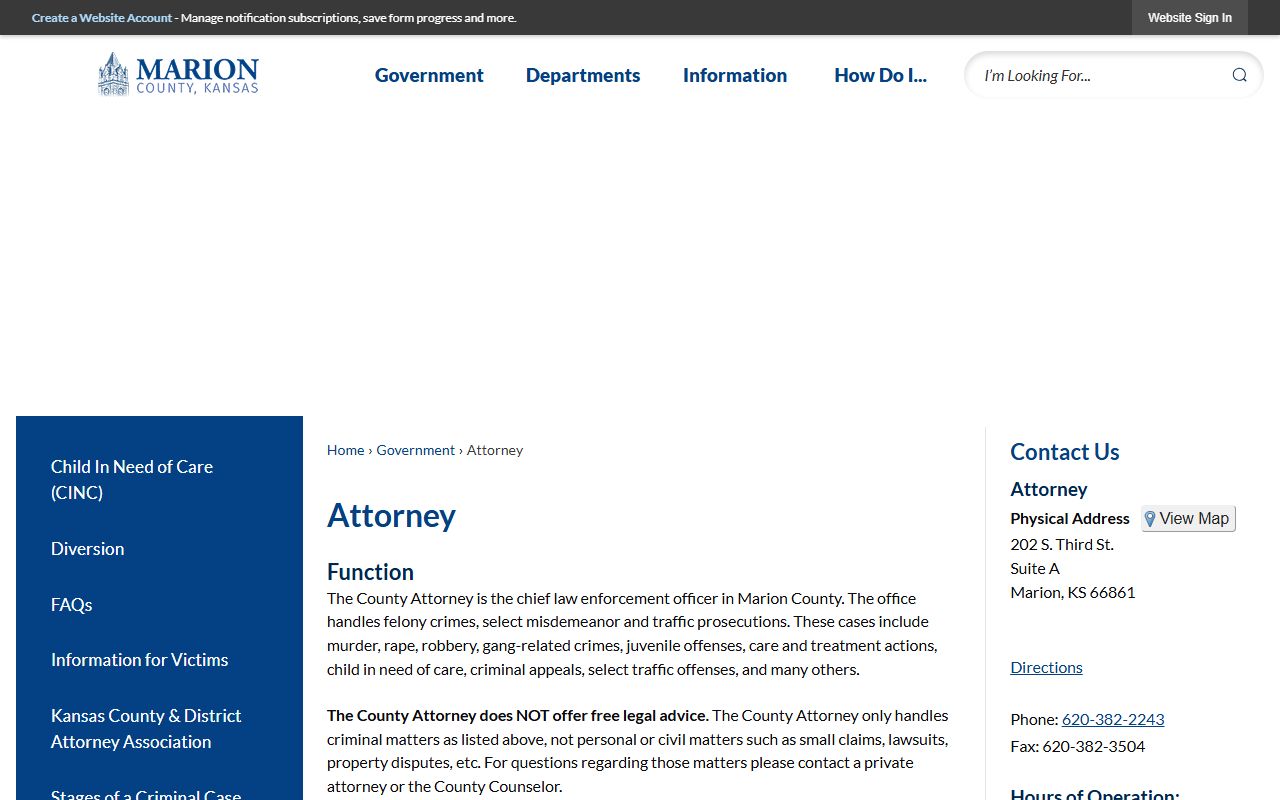
The County Attorney details help place filed charges in context because prosecution work and District Court record keeping are separate steps.
Charges and Convictions Compared
Marion County criminal court records can list charges that did not end in convictions. A charge is an accusation filed in court. A conviction is an outcome after a guilty plea, no contest plea accepted by the court, or trial verdict. This distinction matters when reading a case with amended counts, dismissed counts, diversion, or a sentence on only part of the original filing.
| Point | Charge | Conviction |
|---|---|---|
| Meaning | A filed accusation that a law was violated. | A final finding or plea of guilt on a count. |
| Where it appears | Complaint, information, docket, bond entry, or amended filing. | Disposition entry, journal entry, plea record, sentencing entry, or judgment. |
| May change | Can be amended, reduced, dismissed, or replaced. | Can be appealed, expunged if eligible, or affected by later orders. |
| How to verify | Check each count and later docket activity. | Confirm the disposition and sentencing entry for that count. |
Do not treat the first charge list as the final result. Marion County dockets can include continuances, amended filings, plea negotiations, dismissals, diversion agreements, and sentencing entries after the first appearance. The final disposition is the better field for outcome review.
Sealed and Expunged Criminal Records
Some Marion County criminal records are public, some are public only in a limited way, and some are not public at all. Kansas expungement is a court process. The research file identifies K.S.A. 21-6614 for certain convictions, arrest records, and diversion agreements; K.S.A. 22-2410 for certain arrest records; and K.S.A. 38-2312 for juvenile records. The Kansas Bureau of Investigation fact sheet notes that a person generally files through the court rather than asking KBI alone to erase a record.
| Point | Sealed record | Expunged record |
|---|---|---|
| Public view | Closed by law or court order and not shown to the general public. | Removed from ordinary public view after a qualifying court order. |
| Access after order | May still be available to authorized parties or agencies. | May still be available to courts, law enforcement, licensing bodies, or other agencies under exceptions. |
| How it happens | By rule, statute, case type, or judge's order. | By petition in the court that handled the case or arrest record. |
| Marion County step | Ask the Clerk of the District Court how access is handled. | File or confirm the petition process with the Clerk of the District Court and check the current filing fee. |
The Kansas expungement statute page gives the legal source for many conviction, arrest-record, and diversion expungement requests. View K.S.A. 21-6614 from the Kansas Revisor.
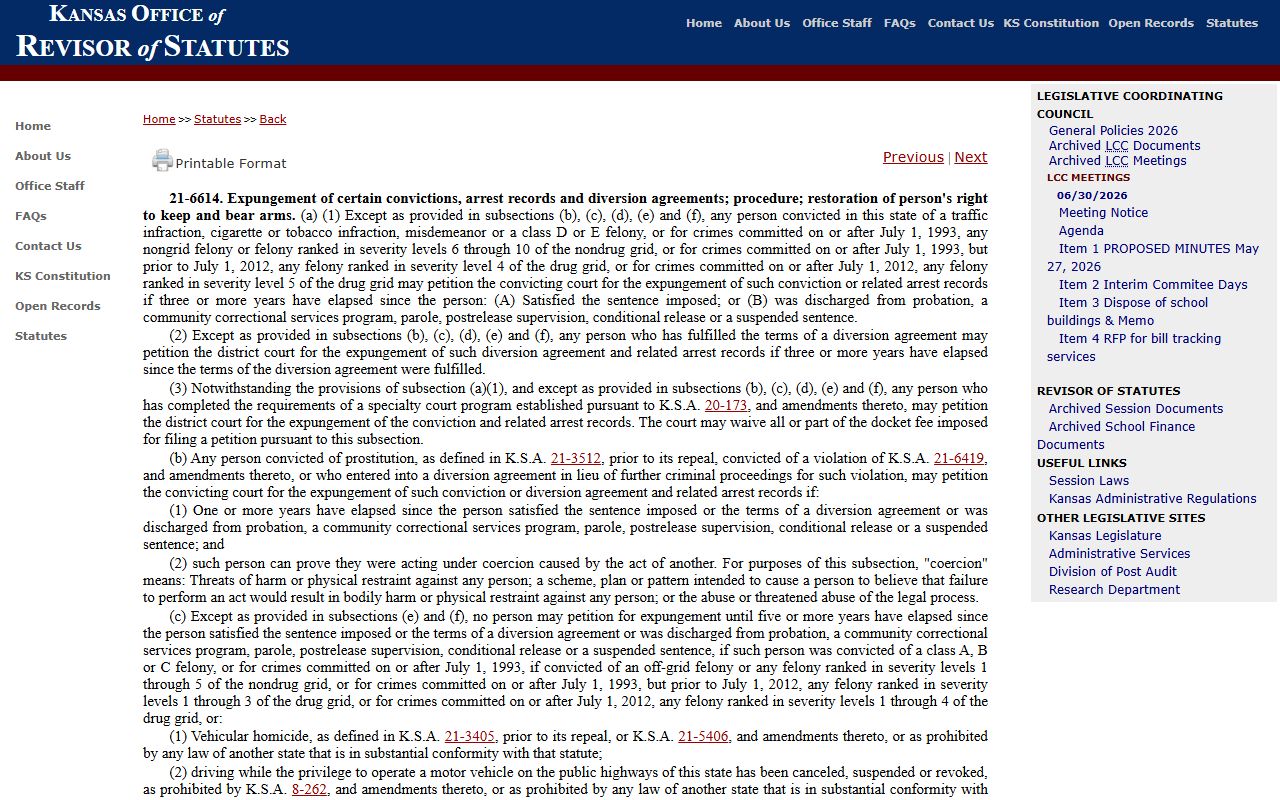
The statute context is important because expungement eligibility depends on the type of record, offense, timing, and the court's order.
Marion County Criminal Records Access
Kansas public access has two overlapping layers. The Kansas Open Records Act favors access to public agency records unless a law closes them, while Kansas Supreme Court Rule 22 governs public electronic access to district and appellate case records. That means a criminal court record may be public but not remotely available. It can also mean a public docket entry appears online while a document must be reviewed at the courthouse terminal or requested from the clerk.
Key access rules: K.S.A. 45-216, 45-218, and 45-219 address Kansas public-record policy, inspection, and fees. Kansas Supreme Court Rule 22 controls public electronic court access and remote limits.
Restricted categories include juvenile offender records, child-in-need-of-care records, adoption, care and treatment or mental health matters, sealed cases, expunged cases, protected addresses, minor identifiers, Social Security numbers, financial account numbers, and sensitive attachments. When an online Marion County criminal search does not show a result, the reason may be a spelling issue, a municipal-court venue, Rule 22 remote limits, a sealed record, or no filed case.
Note: A courthouse terminal may show public information that a remote public search does not display.
Marion County Criminal Record Offices
Several offices can be involved in one criminal matter. The Clerk of the District Court keeps the filed case record. The County Attorney files and manages prosecutions and diversion agreements. The Sheriff's Office handles law enforcement, jail, custody, and warrant execution. The offices sit close together in Marion, but their roles are not interchangeable, so requests should match the record type.
| Office | Address | Phone or contact | Record role |
|---|---|---|---|
| Marion County District Court | 200 S 3rd Street, Marion, KS 66861 | 620-382-2104 | Criminal filings, docket, copies, courthouse terminal, and Clerk of the District Court requests. |
| Marion County Attorney | 202 S. Third St., Suite A, Marion, KS 66861 | 620-382-2243 | Felony, select misdemeanor and traffic prosecutions, diversion, and prosecution filings. |
| Marion County Sheriff's Office | 202 S 4th St, Marion, KS 66861 | Emergency 9-1-1 | Custody, jail, law-enforcement records, and sheriff-held warrant questions. |
District Court phone routing is useful for criminal records. Research lists option 2 for Criminal, Probate, and Juvenile, and option 7 for the Clerk of the Court. County office hours and court hours are generally Monday through Friday, 8 a.m. to 5 p.m., but calling before visiting is still prudent when a certified copy, old file, or restricted record is involved.