
Marion County Arrest Records and Charges
Marion County arrest records begin with a law-enforcement action. A booking or jail record may show a name, arresting agency, arrest date, apparent charge description, bond, court date, case number, warrant number, and charge status if the official JailTracker configuration displays those fields. Those details can be useful, but they do not prove the final filed charge, the plea, or the outcome. Booking information can lag behind court filings or use wording that later changes.
Court charges after arrest start when the County Attorney files a complaint or information in District Court. The Marion County Attorney is the chief law-enforcement officer for prosecution purposes and handles felony crimes plus select misdemeanor and traffic prosecutions. Once charges are filed, the Clerk of the District Court maintains the case file. The full case result, plea, disposition, and sentence belong in Marion County criminal court records, while the jail roster is the better source for current custody and booking-side details.
The Marion County Sheriff page identifies the local law-enforcement office involved in custody and booking access. View the Marion County Sheriff source page.
The sheriff page helps identify the local law-enforcement access point, while the court file remains the source for formal filed charges.
Find Marion County Arrest Records
There is no single official Marion County page that should be treated as a complete arrest-to-conviction database. Use a chain of official sources. For current jail custody, use the county's official JailTracker roster link from the sheriff menu. For filed counts and court status, use Kansas Judicial Branch CaseSearch. For copies or documents not displayed remotely, contact the Clerk of the District Court. For law-enforcement booking records not shown online, use the Sheriff's Office or a Kansas Open Records Act request, subject to law-enforcement limits.
- Check the Marion County JailTracker roster if the question is current custody, booking, bond, or arresting agency.
- Search Kansas CaseSearch by case number, party name, business name, citation, or other available criteria.
- Open the District Court case to review filed charges, count numbers, statute references, hearing activity, and charge status.
- Call the Marion County Clerk of the District Court for certified copies or public documents not shown online.
- Use Kansas VINE for custody notifications and KASPER only for sentenced state-prison offenders, not county booking records.
CaseSearch and JailTracker answer different questions. JailTracker may show current-offender and charge-label information from the jail side. CaseSearch and the clerk show whether a prosecutor filed a court case and how each count moved through the court. When the two do not match, the court filing is the stronger source for charges after arrest.
Charges After Arrest in Marion County
The charge record begins with a charging document. In Kansas District Court practice, the common local record terms include complaint, information, count, statute, arraignment, plea, disposition, conviction, dismissal, sentence, bond, and bench warrant. A person can be arrested before the final charging decision is made, and the prosecutor can amend or dismiss counts as the case develops. That is why court charge records should be read count by count.
| Charging document | Who files or starts it | Common use | What to check |
|---|---|---|---|
| Complaint | Officer or prosecutor, depending on case type and practice | Initial criminal filing or accusation | Offense description, statute, date, count number, and bond entry. |
| Information | Prosecutor | Formal prosecutor-filed criminal charges | Whether it replaces, amends, or adds to the first charge list. |
| Indictment | Grand jury | Less common serious criminal charging path | Filed counts, issuing authority, and later arraignment or plea entries. |
One arrest can produce no filed case, one filed count, or several counts. A later entry may also reduce a felony to a misdemeanor, dismiss a count, add a count, or show diversion. The docket is the place to track that movement.
Marion County Charge Status
Charge status is the current position of a count in the case. It is not the same as the original arrest label. A Marion County District Court record can show a pending count, an amended count, a dismissed count, a guilty plea, or sentencing after conviction. If a charge was part of a diversion agreement, the final result may depend on whether the terms were completed.
| Status | What it means | How to verify it |
|---|---|---|
| Pending | The count is filed and not yet finally resolved. | Check future hearings, bond entries, motions, and the most recent docket date. |
| Amended or reduced | The filed count changed after the original charge. | Look for an amended complaint, information, plea agreement, or journal entry. |
| Dismissed | The court record shows the count ended without conviction on that count. | Confirm whether dismissal applies to all counts or only one count. |
| Diversion | Prosecution is paused under conditions and may later be dismissed if completed. | Check the County Attorney filing, diversion order, compliance terms, and dismissal entry. |
| Convicted | The count ended in a guilty finding or plea accepted by the court. | Review disposition and sentencing entries for the final count result. |
| Warrant or failure to appear | A judge may have issued a bench warrant after a missed required appearance. | Contact the issuing court before assuming payment alone clears the warrant. |
Note: Charge labels in a jail record can be useful leads, but filed court counts control the criminal case record.
Charge Versus Conviction
Marion County arrest records and court charge records often list accusations before any final outcome. A charge may be based on probable cause or a prosecutor filing decision. A conviction requires a guilty plea, accepted no contest plea, or trial verdict. Public records can show both, so the reader must locate the disposition for each count before describing a person as convicted.
| Point | Charge | Conviction |
|---|---|---|
| Record stage | After arrest or prosecutor filing. | After plea, verdict, or accepted court finding. |
| Proof level | Accusation based on filing standards. | Final court finding on a count. |
| Can disappear from outcome | Yes, a charge can be dropped, amended, or dismissed. | Only appears after an adjudicated guilty result or plea. |
| Best field to read | Complaint, information, charge list, and docket amendments. | Disposition, journal entry, sentence, and final judgment. |
This comparison is especially important for cases with multiple counts. A person may face several charges after one arrest, yet only one count may result in a conviction, or all counts may be dismissed after diversion or another ruling.
Marion County Charge Record Fields
Filed charge records often use short labels. A count is one charged offense. A statute is the Kansas law cited for that count. A disposition is the outcome. A sentence is the punishment ordered after conviction. A bond is money or conditions used to secure appearance in court. A bench warrant is a judge's warrant, often tied to failure to appear.
| Field | What it tells you |
|---|---|
| Count | One separate charged offense within the case. |
| Statute | The Kansas law allegedly violated or applied to the charge. |
| Severity or type | Whether the matter is treated as felony, misdemeanor, traffic, juvenile, or another case category. |
| Offense date | The date tied to the alleged conduct, which may differ from filing or arrest date. |
| Arrest date | The custody event date when shown by jail-side records. |
| Case number | The District Court number used to find filings and docket entries. |
| Bond amount and type | Financial or release conditions, if set and public. |
| Court date | The next scheduled hearing or past hearing tied to the charge. |
| Charge status | Pending, amended, dismissed, convicted, diverted, or another local status label. |
The Kansas arrest expungement statute gives the legal source for certain arrest-record cleanup requests. View K.S.A. 22-2410 from the Kansas Revisor.
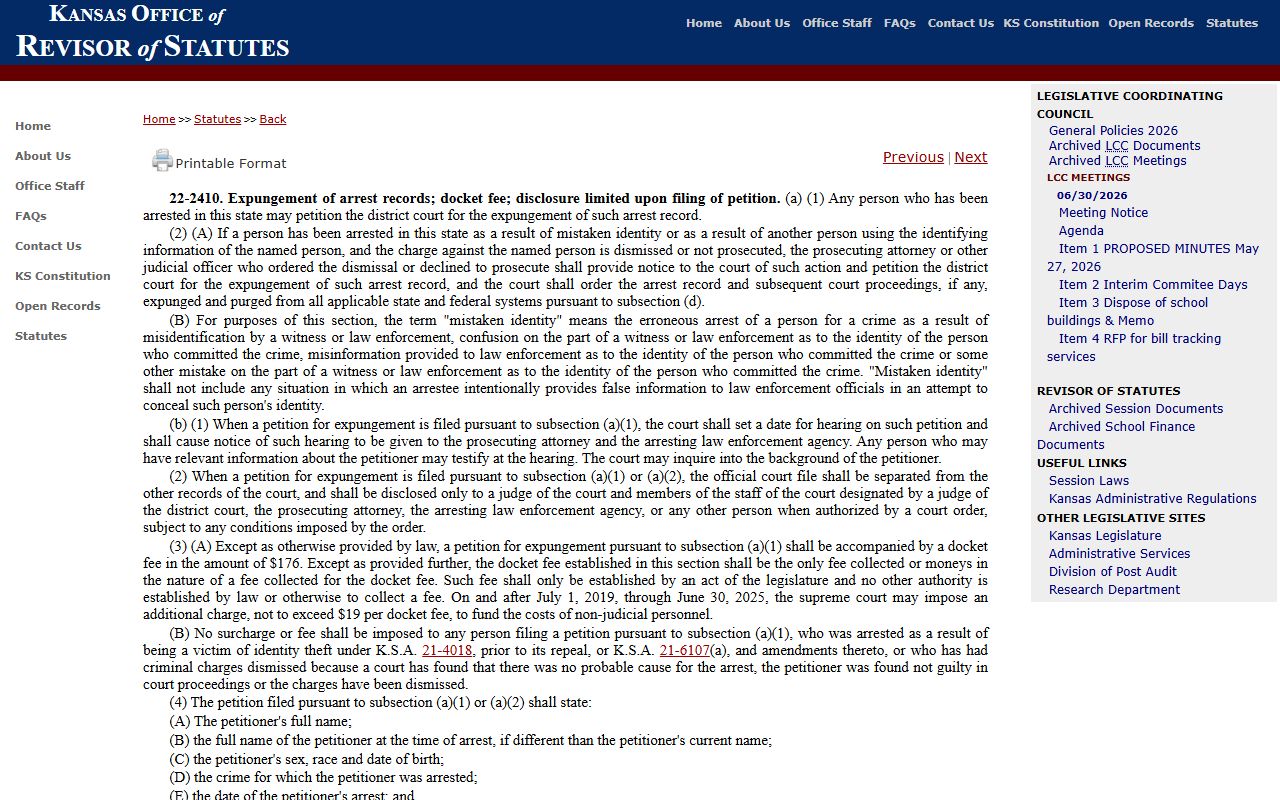
The arrest expungement statute matters because an arrest record can have a different cleanup path from a conviction or full criminal case file.
Access to Marion County Arrest Records
Access depends on which record is being requested. Court charges filed in District Court are searched through Kansas CaseSearch, courthouse terminals, docket PDFs, or the Clerk of the District Court. Sheriff booking records may be requested through the Marion County Sheriff's Office, but law-enforcement exemptions, safety rules, active investigations, and jail security limits can restrict release. Kansas VINE is a notification system for custody status, while Kansas KASPER is for sentenced state-prison offenders and is separate from county jail booking.
Kansas public-record law favors access unless a law closes a record. K.S.A. Chapter 45 contains the Kansas Open Records Act provisions on inspection and fees. Kansas Supreme Court Rule 22 controls remote electronic access to court records. For a Marion County charge record, this means an online result can be limited even when the underlying case information is available at the courthouse.
Access point: Use sheriff or jail channels for custody facts, and District Court channels for filed charges, plea, disposition, and sentence.
Restricted Marion County Charge Records
Some arrest and charge information is restricted from ordinary public access. Juvenile offender records, child-in-need-of-care matters, adoption, care and treatment or mental health records, sealed cases, expunged records, protected addresses, minor identifiers, Social Security numbers, financial account numbers, medical details, and sensitive attachments can be withheld or redacted. An ongoing investigation can also limit law-enforcement release.
| Record status | Public effect | Marion County access step |
|---|---|---|
| Sealed | Closed by law or order and not available through public search. | Ask the issuing court whether any public docket information can be released. |
| Expunged | Removed from ordinary public view after a qualifying court order. | Confirm through the Clerk of the District Court if authorized to receive an answer. |
| Juvenile | Often confidential or limited to parties, attorneys, agencies, and authorized persons. | Use court-authorized channels, not public search assumptions. |
| Active investigation | Law-enforcement records may be withheld to protect the case or safety. | Use an official request and expect exemptions or partial release. |
Expungement in Kansas is not automatic for every arrest or charge. K.S.A. 21-6614, K.S.A. 22-2410, and K.S.A. 38-2312 are key statutes, and the petition generally goes through the court that handled the case or arrest record.
Marion County Charge Record Contacts
Use the office that controls the record being checked. The Clerk of the District Court is the local source for filed criminal cases, certified court copies, courthouse-terminal access, and docket questions. The County Attorney handles prosecution and diversion questions, but the office does not give free legal advice and does not handle private civil disputes. The Sheriff's Office is the correct starting point for jail, custody, and sheriff-held law-enforcement records.
| Office | Address | Phone or contact | Use for |
|---|---|---|---|
| Marion County District Court | 200 S 3rd Street, Marion, KS 66861 | 620-382-2104 | Filed charges, docket, disposition, certified copies, and courthouse terminal access. |
| Marion County Attorney | 202 S. Third St., Suite A, Marion, KS 66861 | 620-382-2243 | Prosecution, traffic diversion, DUI diversion, and filed prosecutor documents. |
| Marion County Sheriff's Office | 202 S 4th St, Marion, KS 66861 | Emergency 9-1-1 | Custody, jail roster, booking records, and sheriff law-enforcement records. |
County office hours are commonly listed as Monday through Friday, 8 a.m. to 5 p.m. District Court phone option 2 routes criminal, probate, and juvenile questions, while option 7 reaches the Clerk of the Court. Call first when the request involves older records, sealed matters, or certified copies.